

Quarterly service is the right baseline for most homes, with monthly visits for active infestations or high-risk properties and annual or biannual inspections for low-risk, well-sealed buildings. Raise the frequency whenever monitoring data or pest sightings cross the thresholds set in your plan. This adaptive approach follows an integrated pest management (IPM) model built on inspection, exclusion, sanitation, monitoring, and targeted treatment rather than one, rather than a fixed calendar alone.
TL;DR:
- Most homes benefit from quarterly pest control visits to maintain residual effectiveness and prevent pest populations from rebuilding within three to four months.
- Properties with active infestations or high risk should receive monthly treatments, while low-risk, well-sealed buildings may only need annual inspections.
- Building an effective pest management plan requires assessing site-specific risks, setting clear threshold triggers, and adjusting frequency based on monitoring data.
- Routine inspections, including monthly interior and exterior checks plus quarterly exclusion audits, are essential for early problem detection and structural prevention.
- Accurate record-keeping of service reports, monitoring logs, and structural findings supports ongoing management and timely escalation when thresholds are crossed.
Table of Contents
- What Is the Right Pest Control Maintenance Schedule for Your Property?
- How Do You Build a Site-Specific Pest Management Plan?
- What Should a Monthly and Quarterly Inspection Checklist Cover?
- How Should Cadence Change for Termites, Rodents, Cockroaches, and Mosquitoes?
- What Records Should You Keep for Pest Control Documentation?
- How Do Professional Providers Structure a Maintenance Contract?
- Why Prevention Beats Reaction Every Time
- Set Up a Maintenance Schedule That Actually Holds
- Useful Resources for Building Your Pest Control Schedule
- Sources
- FAQ
What Is the Right Pest Control Maintenance Schedule for Your Property?
A pest control maintenance schedule works in tiers, and picking the right one starts with an honest look at your property's construction, location, and pest history. There's no single correct answer here. A condo on a high floor with sealed entry points needs far less attention than a ground-level restaurant kitchen backing onto a green corridor.
Annual service fits low-risk properties: newer construction, tight building envelopes, minimal landscaping, and no history of infestation. One inspection a year catches early warning signs before they become expensive problems, provided the exclusion work and sanitation habits are already solid.
Biannual service (twice a year) suits typical suburban homes with moderate risk. Spring and fall visits align naturally with when pests are most active. This is a common step-up from annual for homes with mature trees, wood siding, or a crawlspace.
Quarterly service is the baseline for most residential properties, and for good reason. Most residual treatments lose effectiveness within a season, and quarterly visits keep the chemical and physical barriers refreshed before gaps open up. It also matches the reproductive cycles of common household pests like ants and spiders, which can rebuild a population in three to four months if left unchecked.
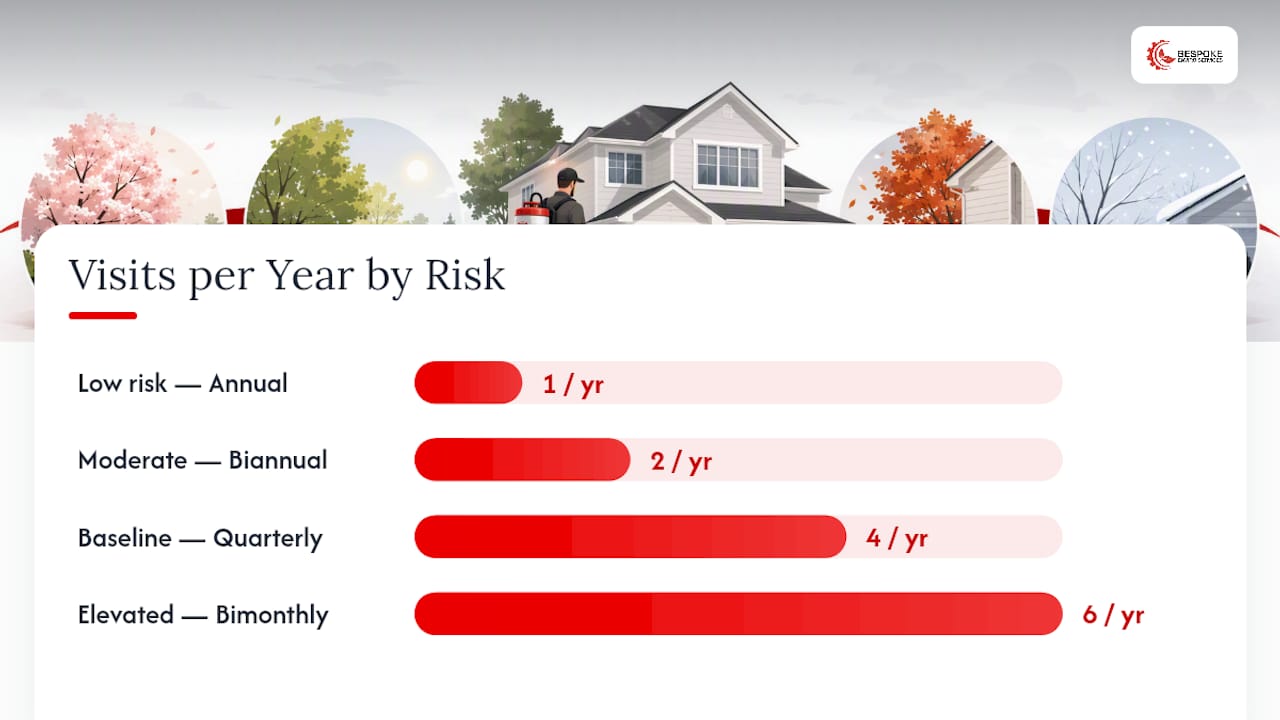
Bimonthly service (every two months) makes sense for older homes, wooded lots, or properties with a documented pest history that hasn't fully resolved. It's a middle ground between routine prevention and full monthly intervention.
Monthly service is reserved for high-risk sites: food service establishments, healthcare facilities, multifamily buildings with shared walls, and any property currently fighting an active infestation. Short-residual contact treatments and fast-breeding pests like German cockroaches simply don't stay controlled on a longer interval.
Here's how those tiers typically map to property types:
- Low-risk single-family home, strong exclusion: annual inspection with seasonal spot treatments
- Typical suburban home, moderate landscaping: biannual service
- Most residential properties: quarterly service as the default
- Older home, wooded lot, or unresolved pest history: bimonthly service
- Food service, healthcare, or active infestation: monthly service
- Multifamily buildings: quarterly baseline, shifting to monthly in units or common areas with sightings
Seasonal pulses also matter regardless of your baseline tier. Mosquito treatments should ramp up before breeding season starts, not after the first bite. Rodents move indoors as temperatures drop, so a fall inspection focused on entry points pays off far more than one scheduled in July. Treatment residual life and pest biology, not convenience, should drive the calendar.
How Do You Build a Site-Specific Pest Management Plan?
A generic schedule pulled from a brochure rarely fits an actual property. Building one that works takes four steps, and each one feeds into the next.
- Assess the site. Walk the property and document pest history, construction gaps, sanitation practices, and what's happening just outside the walls, since a nearby dumpster, drainage ditch, or wooded lot changes your risk profile more than almost anything indoors.
- Choose a cadence and set thresholds. Start with the tier that matches your risk level, then define the specific trigger that moves you up a level. A common threshold is three confirmed sightings of a target species within two weeks, which converts a preventive visit into a reactive monthly follow-up until counts drop back down.
- Assign monitoring roles. The provider handles scheduled visits and targeted treatment. Facility staff or homeowners handle daily or weekly visual checks. A quarterly exclusion audit, covering gaps, seals, and vents, belongs to whoever manages the physical structure.
- Review and adjust. Look at trend data monthly. If sightings are flat or declining, hold your cadence. If they're climbing, escalate immediately rather than waiting for the next scheduled visit.
Scheduling mechanics matter more than people expect. Block the visits on a shared calendar with automatic reminders, not a sticky note on the fridge or a mental note in a property manager's head; for a good example of maintenance scheduling options and plans, see Heat Pump Cleaning and Care Plans | Hita Maine. Every sighting, no matter how minor, should get logged with a date, location, and photo if possible, then escalated to the provider if it crosses your threshold.
Pro Tip: Keep your threshold simple enough to apply without judgment calls. "Three sightings in fourteen days" is something anyone on staff can act on immediately; "significant activity" invites delay while everyone waits for someone else to decide it's bad enough.
This threshold-based structure is the core of IPM programs, which favor monitoring-driven adjustments over rigid calendar intervals. A fixed quarterly visit is a fine starting point, but it shouldn't be the only lever you have when pest pressure spikes between visits.

What Should a Monthly and Quarterly Inspection Checklist Cover?
Between scheduled provider visits, most of the real prevention work happens through routine checks that take a few minutes and catch problems while they're still small.
Monthly interior checklist:
- Check bait stations and glue traps for activity, and reset or replace as needed
- Inspect under sinks, behind appliances, and in storage areas for droppings or nesting material
- Look for moisture buildup near pipes, since damp conditions attract cockroaches and termites
- Verify door sweeps and weather seals are intact at all entry points
Monthly exterior checklist:
- Walk the full perimeter looking for burrows, droppings, or chew marks
- Trim vegetation and mulch back at least 12 to 18 inches from the foundation
- Check dumpster and waste storage areas for overflow, leaks, or standing water
- Confirm exterior monitoring devices are placed and undisturbed
Quarterly exclusion audit:
- Seal any gap larger than a quarter inch in the foundation, siding, or roofline
- Inspect vents, utility penetrations, and rooflines for new openings
- Test door and window seals under load, not just by eye
- Document every finding with a photo and location, and assign a repair deadline, ideally within seven days for critical gaps
Reporting works best when one person owns it. In a home, that's usually whoever manages the property; in a commercial building, facility staff running daily walk routines often catch problems before the provider's next scheduled stop. Every finding should include a photo, a specific location, and a short note on severity so the next reviewer, whether that's you next month or the technician on the next visit, isn't starting from scratch.
How Should Cadence Change for Termites, Rodents, Cockroaches, and Mosquitoes?
Different pests demand different rhythms, and treating them all on the same calendar wastes effort on some while under-protecting against others.
- Termites: an annual inspection is the accepted minimum, since colonies build slowly and damage often stays hidden for years before it surfaces. Properties with a history of activity or nearby infestations benefit from monitoring stations checked twice a year.
- Rodents: cadence should ramp up fast once indoor activity appears. A single confirmed sighting indoors is often enough to trigger monthly service until exclusion work closes the entry points; outdoor bait stations can stay on a quarterly check.
- Cockroaches: once an infestation is confirmed, monthly follow-up visits are standard until trap counts drop to zero for two consecutive checks, at which point service can step back down to the property's baseline tier.
- Bed bugs: the same monthly-until-clear rule applies, though confirmation typically takes longer since bed bugs hide well between feedings; most providers recommend a follow-up two to three weeks after initial treatment, then monthly checks until no activity shows for a full cycle.
- Mosquitoes: cadence is seasonal rather than risk-based. A pre-season barrier treatment a few weeks before your region's typical breeding onset, followed by pulses every one to three weeks during peak season, controls populations far better than a single midsummer treatment.
Matching your treatment residual to the pest's biology is what separates a working schedule from one that just looks tidy on paper. A soil barrier product with a long residual can carry a quarterly gap; a contact spray for cockroaches cannot.
What Records Should You Keep for Pest Control Documentation?
Good documentation turns a maintenance schedule into a program you can actually manage instead of a guess you renew every year. Keep the following on hand at all times:
- Service reports from every provider visit, including what was treated and where
- Pesticide application records, listing product, quantity, and location
- Safety Data Sheets (SDS) for every product used on-site
- Monitoring device logs, tracking bait station and trap reads by date and location
- Photos and site maps marking device placement and any structural findings
Review trend data monthly and run a full program assessment once a year. Consistent trend analysis is what turns raw sighting counts into an early warning system rather than a pile of paperwork nobody reads.
Digital tools make this far easier than a binder ever could. Platforms like MaintainIQ and Oxmaint log inspections in real time, flag trend spikes automatically, and keep records audit-ready without manual data entry. Track four core numbers: sighting counts per period, corrective actions closed versus opened, average time-to-repair on exclusion gaps, and how often your cadence has needed to shift up or down.
How Do Professional Providers Structure a Maintenance Contract?
A competent maintenance contract does more than send a technician through the door on a schedule. Expect four deliverables at minimum: a documented inspection, targeted treatment based on findings rather than a blanket spray, ongoing monitoring device checks, and a written monthly report you can file or hand to an auditor.
Exclusion work deserves its own service level agreement. Most providers commit to repairing critical structural gaps, like those quarter-inch openings that let rodents in, within about seven days of discovery, since delaying exclusion repairs is where most re-infestation risk lives.
A professional pest control provider operates with experienced technicians using eco-friendly IPM methods that prioritize non-toxic treatment wherever it will hold. Monthly reporting is standard practice, giving property owners a running record instead of a one-time invoice.
Why Prevention Beats Reaction Every Time
Pest control is one of the rare maintenance categories where prevention almost always costs less than the cleanup. Structural repairs from an unchecked termite colony or a rodent chewing through wiring dwarf the price of a few extra quarterly visits.
The mistakes we see most often are skipped visits during "quiet" months, sloppy or missing documentation, and leaning on chemical spraying alone while ignoring exclusion. A schedule only works if you follow it. Book an assessment and set your first quarterly visit before pest pressure forces your hand.
— Bespoke-Enviro Services
Set Up a Maintenance Schedule That Actually Holds
Bespoke-enviro builds maintenance contracts around the same threshold logic covered above: monthly, quarterly, or annual visits, adjusted based on real monitoring data rather than a rigid calendar nobody revisits. Every assessment starts with a full site walk, documented findings, and a proposed cadence tailored to your property's actual risk, not a generic package.
If your property already shows signs of active infestation, a scheduled visit alone won't cut it. Our fumigation service handles severe cases that need a full reset before a maintenance plan can hold. For everything else, our general pest control program covers the inspection, treatment, and monthly reporting a solid schedule depends on. Request a site assessment and we'll propose a sample maintenance plan built around your property's specific risk profile, not a one-size-fits-all interval.
Useful Resources for Building Your Pest Control Schedule
- Oxmaint's pest control checklist covers digital inspection features and operational checklist templates.
- MaintainIQ's inspection checklist PDF gives facility teams an audit-ready format for monthly walks.
- Bespoke-enviro's IPM guide explains the monitoring-threshold framework referenced throughout this schedule.
- SFA pest control documentation requirements outlines reporting standards for food businesses.
Sources
- Pest Control Checklist - Oxmaint
- Free Pest Control Inspection Checklist PDF | MaintainIQ
- Pest Control Service Frequency Recommendations | Pest Control Authority
- Pest inspection checklist (PestPro blog)
FAQ
How Often Should Pest Control Be Done?
Quarterly service is the standard baseline for most homes, since it matches how long residual treatments stay effective and how quickly common pests can rebuild a population. High-risk sites or active infestations often need monthly visits, while low-risk properties with strong exclusion can stretch to biannual or annual inspections.
What Are the Three Rules for Pest Control?
There's no single official "three rules" list, but most IPM programs boil down to inspect before you treat, exclude before you rely on chemicals, and monitor continuously rather than treating once and walking away. Bespoke-enviro structures its IPM approach around these same three principles.
How Many Times a Year Should You Go to Pest Control?
For most homes, that means four visits a year on a quarterly schedule. Properties with active pest pressure or a documented history may need six visits (bimonthly) or twelve (monthly), while low-risk homes with solid exclusion can often manage on one or two.
How Long Should Pest Control Treatment Last?
Most residual treatments hold for roughly 60 to 90 days before their effectiveness drops off, which is why quarterly exclusion audits matter so much. Sealing entry points during that audit protects your property even as the chemical barrier fades between visits.
Does Bespoke-Enviro Offer Ongoing Maintenance Contracts?
Yes. Bespoke-enviro structures maintenance contracts around monthly, quarterly, and annual cadences, adjusted to each property's risk profile after an initial site assessment. Current pricing and contract details are available through the general pest control service page.