
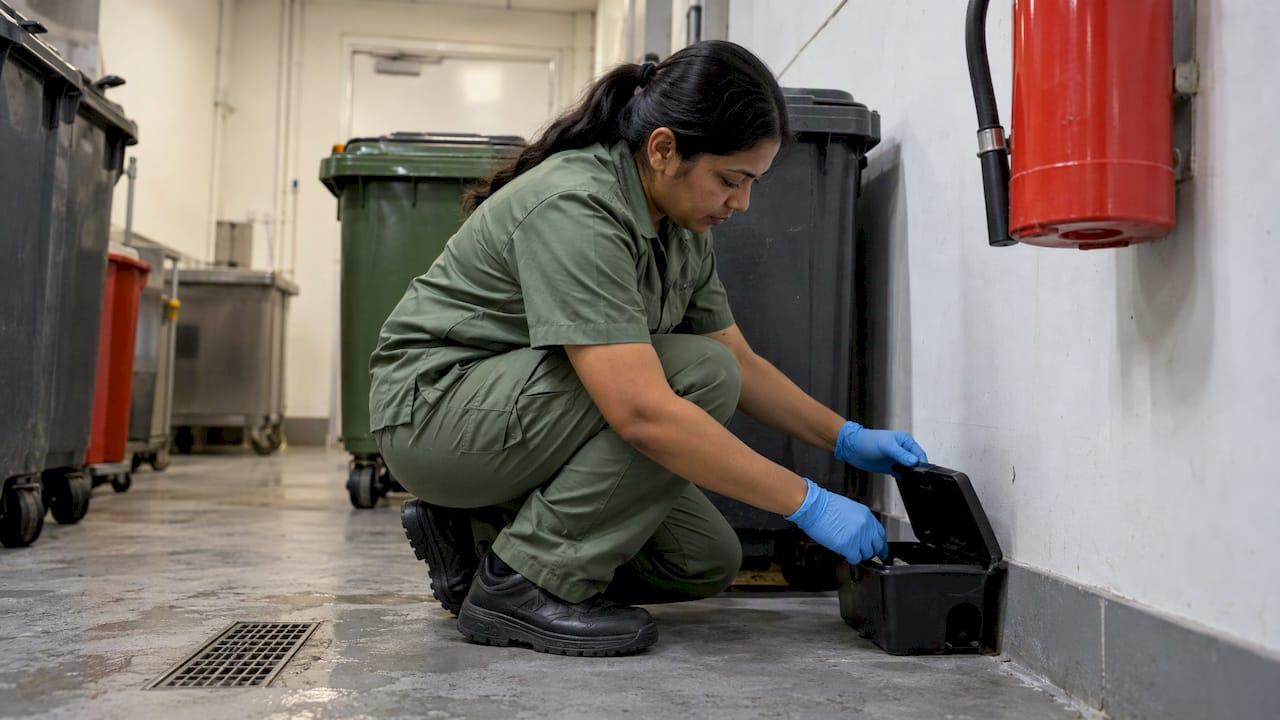
Singapore has no single rulebook titled "hospital pest control". The standard is built from several layers: the national code of practice for pest management services (SS 721:2025), NEA's environmental sanitation codes and the infection prevention guidance now published by the Communicable Diseases Agency (CDA). A hospital programme that meets them is preventive, documented and run by NEA-licensed operators using low-toxicity, targeted methods. That is how we run pest management at Bespoke Enviro Services, and this guide shows what each layer asks for and how to check your own programme against it.
TL;DR
- SS 721:2025 is Singapore's first national standard for professional pest management services. It applies integrated pest management (IPM) across all sectors, including healthcare.
- NEA's specified-premises code asks for a written pest management plan kept on site, a comprehensive survey at least every 6 months and records ready for audit.
- Pests in hospitals are an infection-control issue: a 2026 systematic review links arthropods to antimicrobial-resistant microbes and patient infections.
- Pesticides used in hospitals must be checked for suitability with the supplier or manufacturer before use.
- A report that only says "no major pest issues observed" does not meet NEA's expectations. Reports must name root causes.
Table of Contents
- The standards that apply in Singapore
- Why pests in a hospital are a clinical problem
- What a hospital pest management plan must contain
- Area-by-area measures that auditors look for
- Documentation: what to keep and what to put in the report
- Coordinating pest work with infection prevention
- How to judge a pest control provider for a healthcare site
- Support for your facility
- Our view on hospital pest control
- FAQ
- Sources
The standards that apply in Singapore
Three bodies of guidance shape a hospital's pest programme. Knowing which is which saves time when an auditor or a board asks what you follow.

SS 721:2025. NEA co-developed this code of practice for the performance of pest management services with the Singapore Pest Management Association, under the Singapore Standards Council and Enterprise Singapore. NEA describes it as the first national framework for professional pest management, applying IPM principles in every sector, healthcare settings included. It covers rats, cockroaches, mosquitoes, fleas, flies, biting midges, bedbugs and termites.
The Control of Vectors and Pesticides Act (CVPA) and its regulations. The subsidiary legislation includes the Registration of Pesticides and Vector Repellents Regulations 2023 and the Registration, Licensing and Certification Regulations. In practice this is why the firm treating your wards must be a licensed vector control operator, and why the products it uses must be registered. NEA's circulars page also lists new licensing conditions and revised registration fees effective 1 April 2026 for operators.
NEA's environmental sanitation regime. Mandatory sanitation standards for specified premises were announced in 2020 and progressively implemented from mid-2021. They require a programme with a pest management plan, six-monthly thorough cleaning, incident-response protocols and trained workers. The detail sits in NEA's Code of Practice for Environmental Control Officers for Specified Premises (2nd edition, December 2024).
On the clinical side, the CDA lists the National Cleaning Standards for Acute Healthcare Facilities 2024 and the Infection Prevention and Control Specifications for New Healthcare Buildings (revised 2024). Hospital operators should confirm with NEA and the CDA which instruments apply to their licence category. The NEA codes below are the clearest published benchmark for what an acceptable pest programme looks like.
Why pests in a hospital are a clinical problem
In a hotel, a cockroach is a reputation problem. In a ward, it can be a vector. NEA names five main disease vectors in Singapore: mosquitoes, rat fleas, rats, cockroaches and flies. Between them they are linked to dengue, murine typhus, leptospirosis, cholera, typhoid and salmonellosis, according to NEA's pest control overview. NEA monitors them through surveillance and pre-emptive inspections, and it fines premises when lapses are found.
The hospital-specific evidence is recent. A January 2026 systematic review in Antimicrobial Stewardship & Healthcare Epidemiology found that arthropods in hospitals commonly carry clinically significant and antimicrobial-resistant microbes, including S. aureus, A. baumannii, P. aeruginosa, Aspergillus and Candida. It also found evidence linking them to patient infections, and concluded that stronger pest management and environmental hygiene are essential parts of infection prevention.
The practical consequence: pest control belongs in the infection prevention and control (IPC) conversation, not only in the facilities budget.
What a hospital pest management plan must contain
NEA's vector control operator code of practice (April 2023) describes IPM as a sequence. A plan that follows it covers:
- Identification. Know which species you have, because a German cockroach and a rat need different responses.
- Monitoring and assessment. Track pest numbers and damage over time, not only after a complaint.
- Action thresholds. Decide in advance what count or sign triggers treatment.
- Prevention. Remove the cause: food, water, harbourage and entry points.
- A combination of tools. Biological, cultural, physical or mechanical and chemical methods, used together.
- Evaluation. Assess the effect after each action and adjust.
NEA's SS 721:2025 background page puts the emphasis on prevention first, risk-based assessment, reduced chemical dependency with low-toxicity targeted applications, and continuous monitoring. The shift it describes is from reactive spraying to proactive, science-based IPM. For a hospital, that matches what we aim for: fewer chemical interventions and more removal of the reasons pests are there.
Choosing products for sensitive areas
The operator code states that before use, operators must consult the product supplier or manufacturer on the suitability of pesticides for sensitive environments. It names hospitals, food handling premises and childcare centres. In a hospital this means treatment choices are made per area: a ward, a pantry, a pharmacy store and a loading bay do not get the same product or method. Ask your provider to show how it made that decision for each zone.
Area-by-area measures that auditors look for
NEA's Environmental Sanitation Guidelines for High-Risk Non-Healthcare Premises (updated November 2024) are written for non-healthcare premises, but they are the most specific official list of physical pest measures, and hospital estates teams use the same logic. They specify:
- Covered gullies and rat traps in good condition in corridors and stairwells.
- Bins cleared daily, with no overnight accumulation.
- Cracks in dry risers sealed with wire mesh or caulking.
- Weekly checks of external perimeters for mosquito breeding and rat burrows.
- Inspection of false ceilings and wallboards for infestation.
The specified-premises code adds pest-proofing details: windows and external doors close fitting, with gaps under 6 mm to keep rats out, sanitary systems and grease traps in working order, and proper disposal and sanitisation of any pest carcasses found.
A simple zone map
| Zone | Typical pest risk | What to build into the plan |
|---|---|---|
| Kitchens, pantries, canteens | Cockroaches, flies, rodents | Daily housekeeping checks, grease trap upkeep, monitoring devices |
| Refuse rooms and loading bays | Rats, flies, cockroaches | Daily clearance, sealed doors, perimeter checks |
| Wards and patient rooms | Bedbugs, ants, cockroaches | Inspection after discharges, prompt reporting channel for staff |
| Ceilings, risers, service ducts | Rodents, cockroaches | Sealing gaps, periodic ceiling inspections |
| Compound, drains, planters | Mosquitoes, rats | Weekly perimeter walk, stagnant water removal |
| Rooftops and building edges | Pest birds | Proofing with spikes, netting or repellents |
Structural prevention also depends on knowing who and what moves through service entrances. Logging deliveries and contractors with contactless visitor check-in gives facilities teams a record of access to loading areas, which helps when you trace how an infestation started.
Documentation: what to keep and what to put in the report
NEA's specified-premises code asks for three things that map directly to hospital practice:
- A pest management plan implemented and a copy filed on site.
- A comprehensive pest management survey at least once every 6 months, using the code's Appendix II template.
- All records of pest management works filed so NEA can audit them. The environmental control officer must make them available on request.
The survey is where many reports fall short. NEA's environmental sanitation FAQ says the six-monthly survey must identify potential pest issues, harbourage areas and entry points (including the compound), root causes such as structural defects, refuse management gaps and housekeeping, and better treatment methods. A report that merely states no major pest issues were observed is not sufficient.
A useful service report therefore includes:
- The areas inspected and the method (visual, monitoring devices, thermal imaging where relevant).
- Findings by zone, with species and evidence.
- Root causes, such as a damaged door seal or a refuse-handling gap.
- Treatments applied: product, location and rationale.
- Recommended corrective works and who owns them.
- A comparison with the previous visit.
If you manage a site with a mixed estate, our guides on NEA-aligned pest control schedules and monthly pest reports for food operations show how visit frequency and reporting fit together.
Coordinating pest work with infection prevention
NEA designed the regime so pest control sits inside a wider sanitation programme: the same six-monthly cycle drives thorough periodic cleaning and the comprehensive pest survey. Hospitals can do the same with three habits.
- Share findings with IPC. Send the survey and any outbreak-type findings, such as cockroaches in a sterile supply area, to the IPC team the same week.
- Schedule around clinical activity. Treatments in wards, theatres and food areas need agreed windows, access and re-entry rules set with nursing and facilities.
- Close the loop on defects. When a report flags a gap, crack or drainage fault, track it in the maintenance system until it is fixed. Repeated treatment of an unfixed defect is wasted effort.
For IPC guidance questions, the MOH Health Professionals Portal notes that the NIPC secretariat has moved from MOH to the CDA, and queries go to NIPC_Sec@cda.gov.sg.
How to judge a pest control provider for a healthcare site
Use the standards above as your checklist:
- Licensing. Technicians and the operator are NEA-licensed. Ours are.
- IPM, not calendar spraying. The proposal describes monitoring, thresholds and prevention before chemicals.
- Low-toxicity, targeted methods. Our approach uses non-toxic, environmentally safe treatments that put the safety of people and pets first, which suits occupied buildings.
- Zone-specific product decisions. The supplier consultation required for sensitive environments is documented.
- Diagnostic reports. Root causes and corrective actions, not a tick-box.
- Response time. Pest sightings in clinical areas do not wait for office hours. We are available 24/7.
- Inspection technology. We use thermal imaging for inspections, which helps locate activity behind walls and in ceilings without opening them up.
Support for your facility
Our general pest control service applies IPM to cockroaches, flies, mosquitoes and other common pests. We also handle rodent and rat control, bed bugs, termites, fumigation and bird control and proofing with humane methods. If you are reviewing an existing programme against SS 721:2025 and NEA's survey requirements, contact us and we will walk through your sites with you. Our IPM guide explains the method in plain terms.
Our view on hospital pest control
Most hospital pest problems we are asked about come down to the same pattern: a treatment is booked, the pests return, and nobody has looked at why they were there.
We believe the standard works because it starts with prevention. A hospital that fixes a door gap, controls refuse handling and monitors early will use fewer chemicals and see fewer incidents than one that sprays on a schedule.
That is why we pair non-toxic, environmentally safe treatments with thorough inspection. Thermal imaging lets our NEA-licensed technicians find activity without disruption, and our 24/7 availability means a sighting in a clinical area gets a response when it matters.
Our reports are written to name root causes, so your facilities and infection prevention teams can act on them and your records stand up when NEA asks for them.
Bespoke-Enviro Services
FAQ
Is there one official standard for pest control in Singapore hospitals?
No single document covers it. SS 721:2025 sets the national code for professional pest management services across sectors including healthcare, NEA's codes set plan, survey and record requirements, and the CDA publishes infection prevention standards. Confirm with NEA and the CDA which apply to your facility.
How often should a hospital have a pest survey?
NEA's specified-premises code requires a comprehensive pest management survey at least once every 6 months. Routine monitoring and inspections happen between surveys, and perimeter checks in NEA's guidelines are weekly.
Can hospitals use the same pesticides as other buildings?
Not automatically. NEA's operator code requires consulting the supplier or manufacturer on suitability for sensitive environments such as hospitals before use. Products must also be registered under Singapore's pesticide regulations.
What should a pest control report for a hospital include?
It should list areas inspected, findings, root causes, treatments applied and recommended corrective works. NEA states that a report saying only that no major pest issues were observed is not sufficient.
Sources
- Subsidiary Legislation of the Control of Vectors and Pesticides Act, Singapore Statutes Online
- NEA: Singapore Standard 721:2025 and Integrated Pest Management
- NEA: Pest control overview
- NEA: Pest control circulars and advisories
- NEA: Mandatory environmental sanitation standards for specified premises
- NEA: Code of Practice for Environmental Control Officers for Specified Premises
- NEA: Code of Practice for Vector Control Operator, Technician and Worker
- NEA: Environmental Sanitation Guidelines for High-Risk Non-Healthcare Premises
- NEA: Environmental sanitation regime FAQ
- CDA: Infection prevention and control guidelines and standards
- MOH Health Professionals Portal: IPC guidelines and standards
- Antimicrobial Stewardship & Healthcare Epidemiology: systematic review of arthropod-mediated microbial transmission in hospitals