
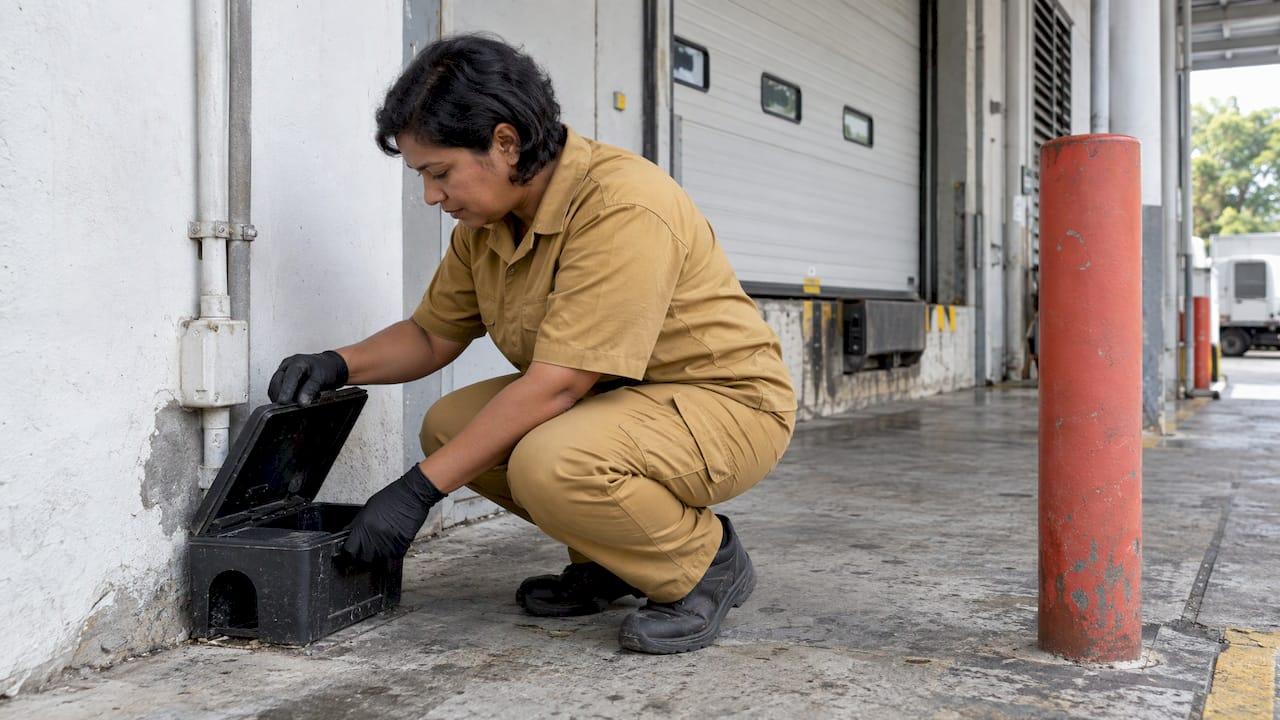
Food manufacturing pest control in Singapore rests on three things: keeping pests out of the building, removing what attracts them, and monitoring so that any activity is caught early. Treatments come last, are carried out by licensed professionals, and are chosen so they do not put food at risk. This guide sets out what the Singapore Food Agency (SFA) and the National Environment Agency (NEA) expect, and how we build a pest management programme around a food factory.
TL;DR
- Food manufacturers need a valid SFA licence, and premises must be designed and maintained to keep out pests, birds, vermin and rodents.
- Rodents, cockroaches and flies contaminate food. Prevention through sanitation, storage and exclusion comes before any treatment.
- Inspect on a fixed schedule, keep written records, and make sure any pest-control company is registered with NEA.
- Where pesticides could contaminate food, physical controls such as traps and proofing are preferred.
- Integrated pest management (IPM) ties all of this together and fits naturally into a HACCP-based food safety system.
Table of Contents
- What Singapore requires of food manufacturers
- Which pests matter most in a food factory
- How an IPM programme works in a food facility
- Sanitation, storage and waste: the daily habits that matter
- Inspection and record-keeping
- Choosing safe treatments around food
- What to do when you find signs of pests
- Pest control for your food facility, handled by Bespoke Enviro
- FAQ
- Sources
What Singapore requires of food manufacturers
Any business that manufactures, processes, prepares or packages food needs a valid licence or registration from SFA. SFA states that operating without one is an offence under the prevailing food-safety laws. Pest control is part of what keeps that licence in good standing.
The SFA conditions of licensing for food establishments require buildings and facilities to be designed to prevent the entry of pests, birds, vermin and rodents. In practice this means:
- openings are screened;
- doors are fitted properly;
- windows are protected with wire screening.
The same document says that where a HACCP system is used, the plan must be kept on file at the food factory, with record-keeping systems that document it.
Responsibility also sits with the people on the floor. NEA and SFA guidance on rat and cockroach prevention assigns operators and food handlers responsibility for effective pest-control measures. It recommends removing food sources, shelter and entry points. A contractor supports your team, but the programme belongs to the facility.
If you also run a restaurant or central kitchen alongside production, our guides on SFA pest control requirements for restaurants and proving a 12-month pest contract with monthly reports cover the documents auditors tend to ask for.
Which pests matter most in a food factory
The pests that cause the most concern are rodents, cockroaches and flies. NEA's food handler handbook explains that they can carry germs and contaminate food, and that eating contaminated food can cause food poisoning and infectious diseases. It also notes that rodents damage property, and that food nibbled by rodents or cockroaches is unsafe to eat.
For a manufacturer, that translates into specific business risks:
- Rodents: gnawing on packaging, insulation and cabling, droppings in raw material stores, and contamination of finished goods.
- Cockroaches: harbourage in warm, damp, hard-to-clean spots such as equipment housings, drains and wall voids.
- Flies: contact with waste and drains followed by contact with product, packaging or food-contact surfaces.
- Birds: nesting and droppings around loading bays, roofs and open dock doors, which also create a route for other pests.
- Other pests: ants, stored-product insects and mosquitoes around outdoor water, depending on what you handle and where the site sits.
A batch rejection, a customer audit failure or a licensing issue costs far more than a prevention programme. That is the case for treating pest control as part of your food safety system, not as a separate service you call when something goes wrong.
How an IPM programme works in a food facility
Integrated pest management starts from one idea: prevent the conditions that let pests live and breed, and use targeted treatment only where monitoring shows it is needed. It fits well with the way Singapore frames food safety.
The SFA licensing conditions describe HACCP as a system built on seven principles: hazard assessment, critical control points, critical limits, monitoring, corrective action, record keeping and verification. The Singapore standard SS 444:2018 presents HACCP as preventive rather than inspection-only. Prerequisite hygiene and manufacturing programmes create the conditions for hazard control, and monitoring and verification show that the controls work. Pest management is one of those prerequisite programmes.
A workable IPM programme for a food factory has five parts:
- Site survey and risk map. We walk the premises, inside and out, and mark entry points, harbourage areas, waste areas, drains and high-risk zones such as raw material intake and open production lines. Our technicians use advanced tools, including thermal imaging, to support inspections.
- Exclusion and proofing. Gaps, doors, drains and openings are corrected so pests cannot enter.
- Sanitation and storage standards. Your team and ours agree on what clean looks like in each zone.
- Monitoring. Devices and scheduled inspections detect activity before it becomes an infestation.
- Targeted treatment and review. Treatment is applied where evidence shows activity. Results are reviewed and the programme is adjusted.
The frequency of visits depends on the size of the site, the products you make and your risk map. Our article on pest control frequency for Singapore sites explains how schedules are matched to the site and kept audit-ready.
Sanitation, storage and waste: the daily habits that matter
Most pest problems in food plants begin with food, water and shelter that were left available. The SFA and NEA guidance gives clear daily practices, and they apply just as well to a production floor as to a kitchen.
Sanitation
- Clean equipment and work areas at the end of operations.
- Remove scraps and spills promptly.
- Clean drains and gullies daily.
Waste
- Empty refuse bins at least daily.
- Keep bins covered, and line foot-pedal bins.
- Bag and tie food waste before disposal.
Storage
- Keep food covered and at least 15 cm above the ground.
- Remove clutter, which gives pests places to hide and makes inspection harder.
All of the above comes from the guidelines on prevention of rat and cockroach infestations. The same document lists exclusion measures that suit factory buildings:
- seal holes and crevices;
- cover floor traps and downpipes with grating;
- install wire mesh at vulnerable openings;
- use air curtains, plastic screens or self-closing doors where doors must open often.
Loading bays deserve special attention. Doors that stay open during deliveries, pallets stacked against walls and damaged dock seals are common ways in. If birds are a problem on your roof or around the bays, humane bird control and proofing with spikes, netting and repellents keeps them away from product and packaging areas.
Inspection and record-keeping
Inspection is how a pest programme proves it works. NEA's handbook recommends checking storage areas at least once a week for signs of pests, and carrying out daily checks for evidence of rodents and cockroaches.
The daily checks look for specific signs:
| Pest | What to look for |
|---|---|
| Rodents | Burrows, droppings, smear marks, gnaw marks, live rodents |
| Cockroaches | Droppings, live cockroaches, egg cases, a pungent odour |
The handbook source for these checks is the same NEA food handler's handbook cited above. Staff who walk production and storage areas every day are your first line of detection. Dedicated, easy-to-clean workwear such as food industry coveralls for staff also supports a consistent hygiene routine on those daily rounds.
What to record
Under the SFA conditions, effective record-keeping is required to document a HACCP plan, and the plan must be on file at the factory. For pest control, a sensible record set includes:
- the site map showing monitoring devices and their locations;
- dated inspection findings from your own checks and from your contractor's visits;
- any sighting reports and the corrective action taken;
- treatment records, including what was applied, where and by whom;
- review notes showing that the programme was adjusted when conditions changed.
We provide written service reports after each visit so that the records your auditors ask for are already in order. For kitchen-based operations, our kitchen pest control checklist gives a ready format you can adapt.
Choosing safe treatments around food
Treatment in a food plant has two goals: remove the pest, and protect the product and the people. The SFA and NEA guidance says to prefer physical pest-control measures when pesticides could pose a contamination risk, and to inspect traps daily. Where chemical controls are necessary, trained personnel should handle the pesticides.

That guidance shapes how we work. Our approach relies on non-toxic, eco-friendly methods within an integrated pest management framework, designed to put the safety of people and pets first. In a food area that means proofing and trapping first, with any further treatment planned around production schedules.
Check who is doing the work
NEA's code of practice for vector control operators, technicians and workers (2nd edition, 5 April 2023) requires companies undertaking vector-control work to be registered as Vector Control Operators. Their personnel must be licensed Vector Control Technicians or certified Vector Control Workers. Our technicians are NEA-licensed.
The same code sets rules on product choice. Pesticide selection must match the identified target vector and the product label. The least hazardous effective option should be used, in the least amount possible. Repeated use of the same active ingredient should be avoided to reduce resistance. A contractor who follows these rules will choose treatments for a reason and will be able to explain that reason in the service report.
When fumigation is the right tool
Some situations, such as heavy infestations in stored goods, packaging or empty structures, call for fumigation. It is planned separately, with the area cleared and sealed and re-entry controlled. Our fumigation services in Singapore are scheduled around your production so that treated areas are handled correctly before food work resumes.

What to do when you find signs of pests
A sighting does not mean the programme has failed. It means monitoring is working, provided you act quickly. A sound response follows a clear order:
- Record it. Note the date, location, pest type and what was seen: droppings, gnaw marks, live insects, egg cases. Photograph it if you can.
- Contain the area. Stop movement of open product and materials from the affected zone until it has been assessed under your own food safety procedures.
- Call your pest control provider. Give them the record. A technician should inspect, find the entry point or harbourage and confirm the species, because the treatment depends on it.
- Fix the cause. Seal the gap, remove the food or water source, clear the clutter. Treatment without this step only delays the next sighting.
- Decide on product. Your quality team assesses any product that may have been exposed, following your HACCP plan and corrective action procedures.
- Review and document. Record the corrective action and check at the next inspection that activity has stopped. If it has not, the programme is adjusted.
For rodent activity in particular, speed matters because the sign you see is rarely the whole picture. Our rodent and rat control services combine inspection, proofing and trapping, with 24/7 availability for urgent callouts.
Our perspective
We have spent over 30 years working in Singapore's pest control industry, and we see the same pattern in food facilities. The sites that stay clean are not the ones that spray most often. They are the ones that treat pest control as a system: exclusion first, sanitation agreed between your team and ours, monitoring that someone actually reads, and treatment only where the evidence points.
That is why we build every food-sector programme on integrated pest management, using non-toxic, environmentally safe methods that put people and pets first. It suits food production because it keeps chemical use away from product, and it produces the dated records your HACCP plan and auditors need.
Our technicians are NEA-licensed, and we use advanced technology such as thermal imaging to support inspections. We are available 24/7, because a rodent in a raw material store does not wait for office hours. We believe a food manufacturer should know what is being done on its site, why, and what the next step is.
Bespoke-Enviro Services
Pest control for your food facility, handled by Bespoke Enviro
We deliver eco-friendly pest management for residential, commercial and industrial clients across Singapore, including food manufacturing and processing sites. Our general pest control services cover inspection, IPM planning, monitoring and treatment for rodents, cockroaches, flies, mosquitoes and birds, with options for one-time treatment or an ongoing maintenance contract.
To discuss your facility, contact Bespoke Enviro Services for a site inspection and a programme matched to your production and audit needs.
FAQ
Does a food manufacturer in Singapore need a pest control contract?
SFA requires premises to be designed and maintained to prevent the entry of pests, birds, vermin and rodents, and puts responsibility for effective pest control on the operator. The sources we reviewed do not prescribe a specific contract format. Most manufacturers use a licensed contractor with regular service visits, because it gives them inspection records and expert treatment.
How often should we inspect for pests?
NEA's handbook recommends checking storage areas at least once a week and carrying out daily checks for signs of rodents and cockroaches. Professional visits are scheduled on top of this, with the frequency set by your site's risk map. Larger or higher-risk sites usually need more frequent visits.
Are chemical treatments allowed in a food factory?
The SFA and NEA guidance prefers physical measures where pesticides could contaminate food. Where chemical controls are needed, trained personnel must handle them. NEA also requires that pesticides match the target pest and label, with the least hazardous effective option used in the least amount possible.
How can I tell if a pest control company is properly licensed?
NEA's code of practice requires companies doing vector-control work to be registered as Vector Control Operators. Their personnel must be licensed Vector Control Technicians or certified Vector Control Workers. Ask any contractor to confirm these. Our technicians are NEA-licensed.
What should we do if we find droppings in a storage area?
Record and photograph the evidence, contain the area under your food safety procedures and call your pest control provider for an inspection. Then fix the entry point or food source behind it. Our rodent control team is available 24/7.
Sources
- SFA: Conditions of licensing for food establishments
- SFA: Businesses that need licence or registration for food manufacturing and storage
- SFA: Guidelines on prevention of rat and cockroach infestations at food establishments
- NEA: Food handler's handbook
- NEA: Code of practice for vector control operator, technician and worker
- Singapore Standard SS 444:2018 (HACCP)