

The most effective, food-safe way to control house flies in a restaurant is an integrated pest management (IPM) approach: source removal, physical exclusion, and kitchen-safe trapping, backed by a documented professional program if flies persist. Immediate priorities are covering exposed food, sealing entry points, and isolating any drain or dumpster breeding sites. If drains are involved, that's usually a signal to call a licensed provider rather than reach for a spray can.
TL;DR:
- Regular drain cleaning with enzyme or bio-based cleaners more effectively reduces fly breeding sites than bleach, preventing recurring infestations.
- Installing waterless drain seals and sealing gaps in windows and doors can significantly decrease fly entry and emergence in the dining area.
- Insect light traps should be mounted high and out of sight, with annual bulb replacements, to minimize contamination risk near food preparation zones.
- Daily sanitation tasks like brushing drains and emptying grease traps are crucial since targeting larvae prevents fly populations from reestablishing.
- When flies persist despite sanitation, a licensed pest control service can identify hidden breeding sources and implement tailored IPM strategies, including fumigation if needed.
Table of Contents
- What Attracts Flies to a Restaurant Kitchen
- The First Hour: Reducing Visible Flies During Service
- Sanitation Habits That Stop Flies From Breeding
- Sealing the Building: Exclusion That Actually Works
- Choosing Food-Safe Traps and Bait Stations
- Building a Monitoring and Staff Training Routine
- When It's Time to Call a Professional
- Your One-Hour and Ongoing Checklist
- Why Most Restaurants Get Fly Control Backwards
- How Bespoke-Enviro Services Supports Restaurant Fly Control
- Sources
What Attracts Flies to a Restaurant Kitchen
Not every fly problem starts the same way, and knowing where flies breed changes what you do about them. House flies favor decaying organic matter in warm, moist conditions. That description fits several spots in almost any commercial kitchen.
- Floor drains and mop sinks: biofilm buildup inside pipes gives larvae a stable food source.
- Grease traps: fat and food particles create ideal breeding conditions if not emptied on schedule.
- Dumpsters and outdoor bins: odor plumes drift toward doors and windows, pulling adult flies indoors.
- Bar stations: sticky soda lines and citrus residue attract fruit flies specifically.
- Under-equipment gaps: food debris collects where cleaning crews rarely reach.
Species identification matters because the fix differs. House flies breed in solid organic waste, drain flies breed in the slime coating drain pipes, and fruit flies breed in fermenting liquids and produce. Treating a drain fly problem like a dumpster problem wastes time and money.
The First Hour: Reducing Visible Flies During Service
When flies show up mid-service, you need action, not analysis. Work through these steps in order.
- Cover or refrigerate all exposed food immediately.
- Close back doors and any propped-open windows.
- Check dumpster lids are latched and sealed.
- Wipe down bar mats, soda gun holsters, and drain covers.
- Deploy temporary sticky traps near the fly activity, not over prep surfaces.
- Remove any visible rotting produce, spilled liquids, or trash bags.
- Use a flyswatter over non-food surfaces only, never near open dishes.
- Avoid aerosol insecticide anywhere near food, plates, or utensils.
- Note where flies concentrated for follow-up cleaning after close.
- Flag the drain or bin location for deep cleaning at shift end.
Pro Tip: Hang sticky traps at eye level near suspected entry points, not directly above prep tables. A trap positioned wrong just becomes another thing a health inspector photographs.
These steps buy you an hour. They don't fix a breeding source, and if flies return within a day or two, the problem is structural, not situational.
Sanitation Habits That Stop Flies From Breeding
Fly control fails most often because sanitation targets adult flies instead of the larvae producing them. A restaurant can spray every night and still have flies the following week if the breeding source in the drain or grease trap goes untouched. That's the core lesson behind Texas A&M's IPM action plan for house flies and filth flies, which treats non-chemical sanitation and exclusion as the primary defense, with pesticides reserved for professional knockdown only.
End-of-shift tasks:
- Mechanically brush floor drains, not just rinse them.
- Apply enzyme or bio-based drain cleaners rather than bleach.
- Flush drains with hot water to loosen residual grease film.
Weekly and deep-clean tasks:
- Pull back equipment to clean the gaps underneath and behind.
- Inspect and empty grease traps on a fixed schedule, not "when someone remembers."
- Reposition dumpsters upwind of entrances where the layout allows it, with lids sealed between pickups.
Bleach and short aerosol knockdowns feel productive but rarely solve anything. Bleach disinfects surfaces without breaking down the biofilm layer where drain fly larvae actually live, and enzyme-based cleaners combined with mechanical scrubbing perform better against that biofilm than chemical disinfectants alone. A restaurant that relies on nightly spraying is treating symptoms, not the source, and the flies will be back within days.
Sealing the Building: Exclusion That Actually Works
Sanitation removes the food source. Exclusion stops new flies from getting in and stops drain-bred ones from emerging into the dining room in the first place. Both matter, and most restaurants only do the first.
- Install air curtains above back and delivery doors, angled to blow downward at roughly a 15 to 20 degree angle toward the opening, creating a barrier flies won't cross.
- Fit door seals and automatic door closers so gaps don't sit open during deliveries.
- Repair torn window screens promptly. A quarter-inch gap is enough for a house fly.
- Install waterless trap seals on floor drains that see infrequent use. These one-way valves let water flow down but block adult flies from flying back up through the pipe.
Waterless seals are often the permanent fix for drains that keep producing flies no matter how often they're cleaned, since physical sealing prevents adult emergence even when some biofilm remains between cleanings. Maintenance still matters: check screen integrity monthly, and if you use insect light traps, they need annual bulb replacement to keep UV output strong, covered in the next section.
Choosing Food-Safe Traps and Bait Stations
Not every trap belongs in a dining room, and not every trap belongs outdoors. Placement is where most restaurants go wrong even when they've bought the right equipment.
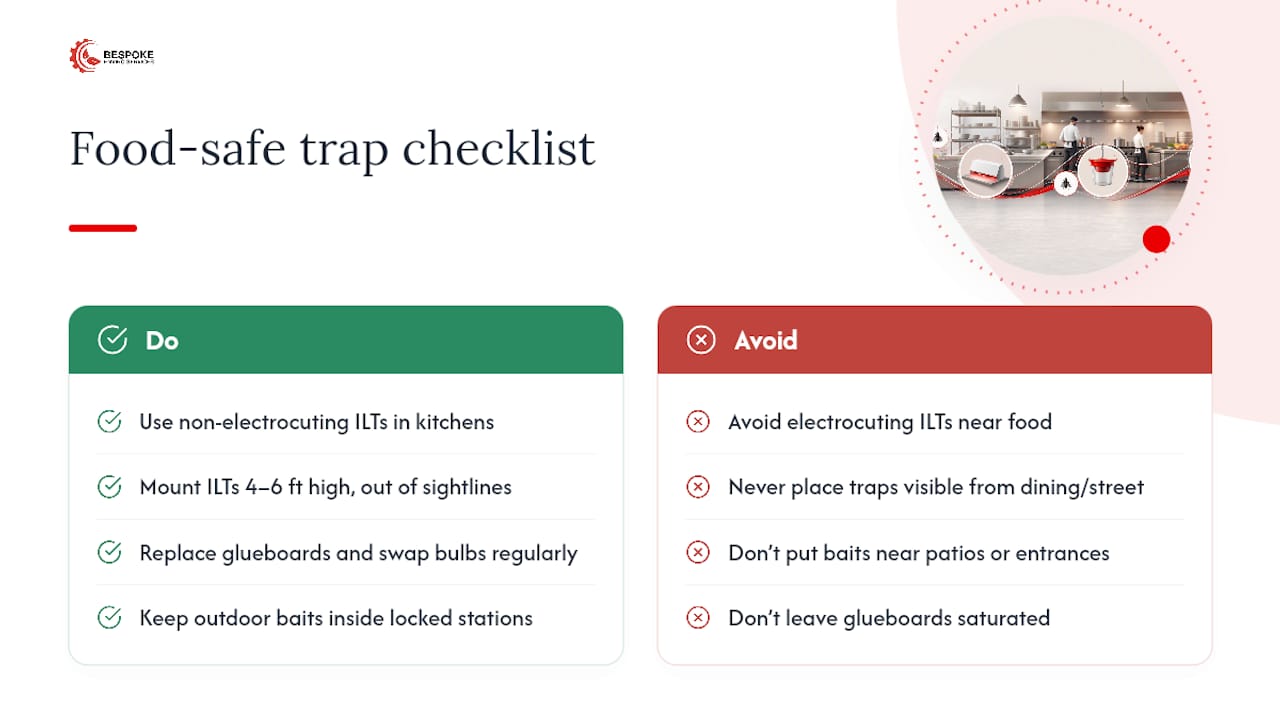
Insect light traps (ILTs): non-electrocuting models are strongly preferred in food-service kitchens because electrocuting units scatter fly fragments into the air, a genuine contamination risk near open food. Industry guidance recommends mounting ILTs between 4 and 6 feet high, positioned out of food-prep sightlines and never visible from the dining room or street. Replace glueboards on a set schedule and swap bulbs annually, since UV output fades well before the tube visibly fails.
Glueboards and sticky tubes: these work well tucked near dumpsters, in dish pits, and along back-of-house walls where foot traffic is light. Swap them before they're saturated, since a full glueboard stops trapping and starts attracting attention for the wrong reason.
Outdoor bait stations: fly baits and strips belong near dumpsters only, secured inside locked bait stations, never near patios or building entrances. Check labels for humidity tolerance, since baits break down fast in wet or exposed conditions.
Pro Tip: Walk your dining room from a seated customer's eye level once a month. If you can spot a glueboard or ILT from a table, it's mounted in the wrong place.
Building a Monitoring and Staff Training Routine
A control program only works if someone checks it consistently and writes down what they find. Health inspectors routinely ask for that record, and NPMA guidance treats service logs as a standard expectation for retail food operations, not an extra step.
- Map every trap and monitoring point on a simple floor plan.
- Check high-risk zones, drains, dumpster areas, and bar stations, daily.
- Check lower-risk traps weekly.
- Log date, findings, and corrective action taken for every check.
- Attach a photo when activity is unusual or a repeat problem.
- Train staff to flag standing water, open bags, or drain odors on sight.
- Assign clear ownership: who checks drains, who empties grease traps, who signs off.
A written IPM program turns these habits into something you can hand an inspector instead of explaining verbally.
When It's Time to Call a Professional
Some fly problems are beyond what internal sanitation and trapping can fix. Recognizing that early saves money and protects your health inspection score.
- Flies breeding inside drains despite regular cleaning and brushing.
- Recurring swarms that return within days of treatment.
- Multiple fly species present at once, suggesting more than one breeding source.
- Internal controls that haven't reduced activity after two to three weeks of consistent effort.
A proper commercial IPM program includes a written plan specific to your premises, source elimination work, non-residual targeted controls, a scheduled monitoring calendar, and documentation you can produce on demand. Before signing a contract, ask what the inspection report covers, how often follow-up visits happen, and whether drain sealing is included or billed separately. A facility drain maintenance guide is a useful reference if you're building your own preventive schedule alongside a contractor's visits.
Your One-Hour and Ongoing Checklist
Keep this near the manager station, not buried in a drawer.
Emergency, do within the hour:
- Cover exposed food.
- Seal doors and check window screens.
- Confirm dumpster lids are closed.
- Deploy sticky traps away from prep areas.
- Remove visible rotting waste.
- Note the source location for deep cleaning.
Daily: brush drains, wipe bar mats, empty visible trash. Weekly: empty grease traps, check ILT glueboards, inspect screens. Monthly: replace ILT bulbs if due, audit trap placement, review service log.
| Task frequency | Key actions | Who signs off |
|---|---|---|
| Daily | Drain brushing, bar cleaning, trash removal | Shift lead |
| Weekly | Grease trap emptying, glueboard check | Kitchen manager |
| Monthly | Bulb replacement, screen audit, log review | General manager |
Store completed checklists with your health inspection paperwork so both live in one place.
Why Most Restaurants Get Fly Control Backwards
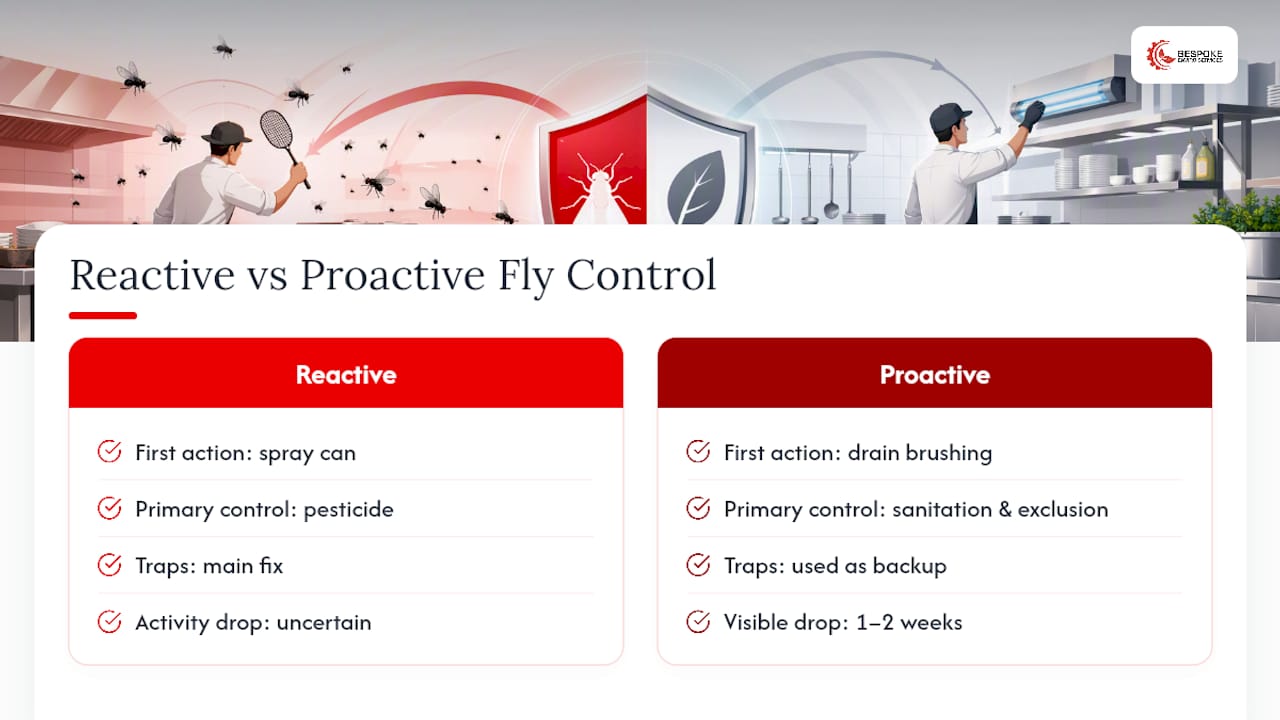
Pest problems often play out the same way in restaurant kitchens: management reaches for a spray can when the actual fix can be a simple drain brushing. That instinct is understandable. A spray feels like action. A dirty drain feels like a cleaning problem, not a pest problem, until the flies prove otherwise.
The restaurants that get ahead of fly issues treat sanitation and exclusion as the real controls, and traps as backup, not the other way around. Expect a properly diagnosed IPM program to show a visible drop in activity within one to two weeks, with full resolution typically requiring a full cleaning and monitoring cycle. We can't promise a specific number for every kitchen, since drain age, layout, and staff discipline all move that timeline. A documented plan, not a reactive one, is what typically holds up under a health inspector's questions.
— Bespoke-Enviro Services
How Bespoke-Enviro Services Supports Restaurant Fly Control
Sanitation and exclusion handle most of the work, but drain-breeding flies and recurring swarms often need a licensed hand. Bespoke-enviro brings commercial general pest control built around IPM principles, non-toxic where possible, and structured around documentation you can actually hand to a health inspector.
A first inspection typically maps your fly hotspots, drains, grease traps, and dumpster zones, and results in a written IPM plan covering source elimination, ILT placement and maintenance, and a monitoring schedule tailored to your kitchen's layout. Recurring maintenance plans are adjusted as your service history shows where activity persists. For structural infestations where flies are breeding deep in inaccessible plumbing, fumigation services may be part of the recommendation. Reach out for a restaurant inspection and get a documented plan built for your premises, not a generic spray schedule.
Sources
For managers who want the original guidance behind this playbook: the NPMA's retail food facility pest guidelines cover documentation standards, Texas A&M's IPM action plan details non-chemical control priorities, and the PMC review of alternative fly controls examines ILT effectiveness. Green Drains and Fruit-flies address drain and bar-specific breeding sources in more depth.
- Pest management guidelines for retail food handling facilities and restaurants — NPMA
- IPM action plan for house flies and filth flies — Texas A&M School IPM
- Drain flies in restaurants: causes, costs, and how to get rid of them — Green Drains